
Chip And Dale Rescue Rangers Gameplay
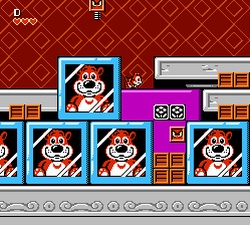
From the first screen, Chip ’n Dale: Rescue Rangers feels like the perfect evening game: you snatch the nearest crate and a heartbeat later it’s streaking into a bug, a mousetrap, or one of Norton Nimnul’s mechanical critters. There’s no timer, yet the pace stays brisk: short hops, snappy tosses, quick breaths to line up a shot. The NES classic builds its rhythm around one simple thrill—grab, carry, and chuck—and the knack for ducking into a box at just the right moment when something sharp and very unwelcome starts flying across the screen.
Throws, cover, and the game’s heartbeat
No head-stomps here—the rule is simple: it’s safer (and cooler) to throw. Crates, cans, apples, even little mystery boxes—level clutter becomes your arsenal. The throw button snaps like a mouse click: crisp, fast, but all about spacing. Get too close and you’ll clip a hitbox and lose a heart; hesitate and you’ll whiff. The best feeling is snagging an item mid-air and redirecting it instantly, like dribbling through defenders. And if things get hairy, crouch with a box overhead and wait out the barrage—the signature “hide-in-the-box” trick that turns late-game gauntlets from spike-and-spark storms into solvable patterns.
Traps set the tempo. Fans push you back, moving platforms nudge you into enemies, conveyors slide your sneakers sideways, and at the edges buzz quick bees and springy gizmos. Each area is a little timing carousel: step, pop-up, pause, throw. No need to sprint blind—the game rewards steady, measured progress and clean clears. Find a nut and patch a heart; grab a star and stash it for the post-stage bonus reel where you might spin up an extra life.
Two-player co-op — sparks flying
With a friend, Rescue Rangers really sings. Player Two isn’t backup—they’re a force of nature. Boost your partner to a top shelf to snag hidden flowers and stars, or… accidentally yeet them into a pit and then panic-save, pelting cover crates like a hero. There’s that classic couch co-op chemistry: tight callouts on who shields with a box, who clears the lane, who takes a run-up for the long throw. It’s not about carrying a weaker player—it’s about syncing to each other’s rhythm.
Pick your route
The lettered map is a tiny slice of freedom: chart your own run. Hit the park and sewers, or take the rooftops and Nimnul’s labs, then on to the casino lights and Fat Cat. Different branches lean into different hazards and difficulty spikes, and two-player co-op makes bolder routes feel doable. Along the way friends pitch in: Gadget fixes bridges and opens shortcuts, Monty smashes obstacles if you reach the right spot, and Zipper whirls in with a burst of temporary invincibility—seconds of pure bravado to sprint ahead and rapid-fire those throws.
Small secrets, big habits
The game teaches you to peek into cracks. Behind a barely-there ledge sits a 1-up or a star for the bonus. That “extra” box? It’s exactly what saves you from a low-swooping bee. You develop a mouse’s eye: gauge jump heights, decide between a light item for quick chains or a heavy one to bulldoze a blockade. The controls get tactile—you feel where to release so the arc nails an enemy’s timing, and how to catch it back for round two. That’s the cozy platformer groove that makes Rescue Rangers a smile-trigger decades on.
Boss fights — sharp, short duels
Every boss is a bite-size reaction puzzle. You read the pattern fast: flashing weak spot, projectile waves, a window to throw. No fancy combos—just clean timing and tidy footwork. Sometimes you lob upward; sometimes you turtle under a crate and wait for an opening. As you go, the duels grow tenser but stay fair: you can see the field, predict the next wave, and seize the moment. The final standoff in Fat Cat’s lair is pure “one more try and I’m done”—your hand reaches for the pad and you know the last throw will land this time.
There’s a warm little math to Chip ’n Dale: Rescue Rangers: no timer, yet constant momentum; no jargon, just a clear loop—pick up, throw, hide, move on. It hooks in solo and in tandem: from your first stroll learning to use a crate as a shield, to late stages with conveyors, fans, and mean critters. It’s the kind of retro platformer where muscle memory and your thumbs decide, and the words “Chip ’n Dale” alone tune you to that breezy adventure beat—where every clean, well-placed crate feels like a tiny victory.